

Moving from a Side Effect to a System Architect: A Guide for Meaningful Life with Einstein and Frankl
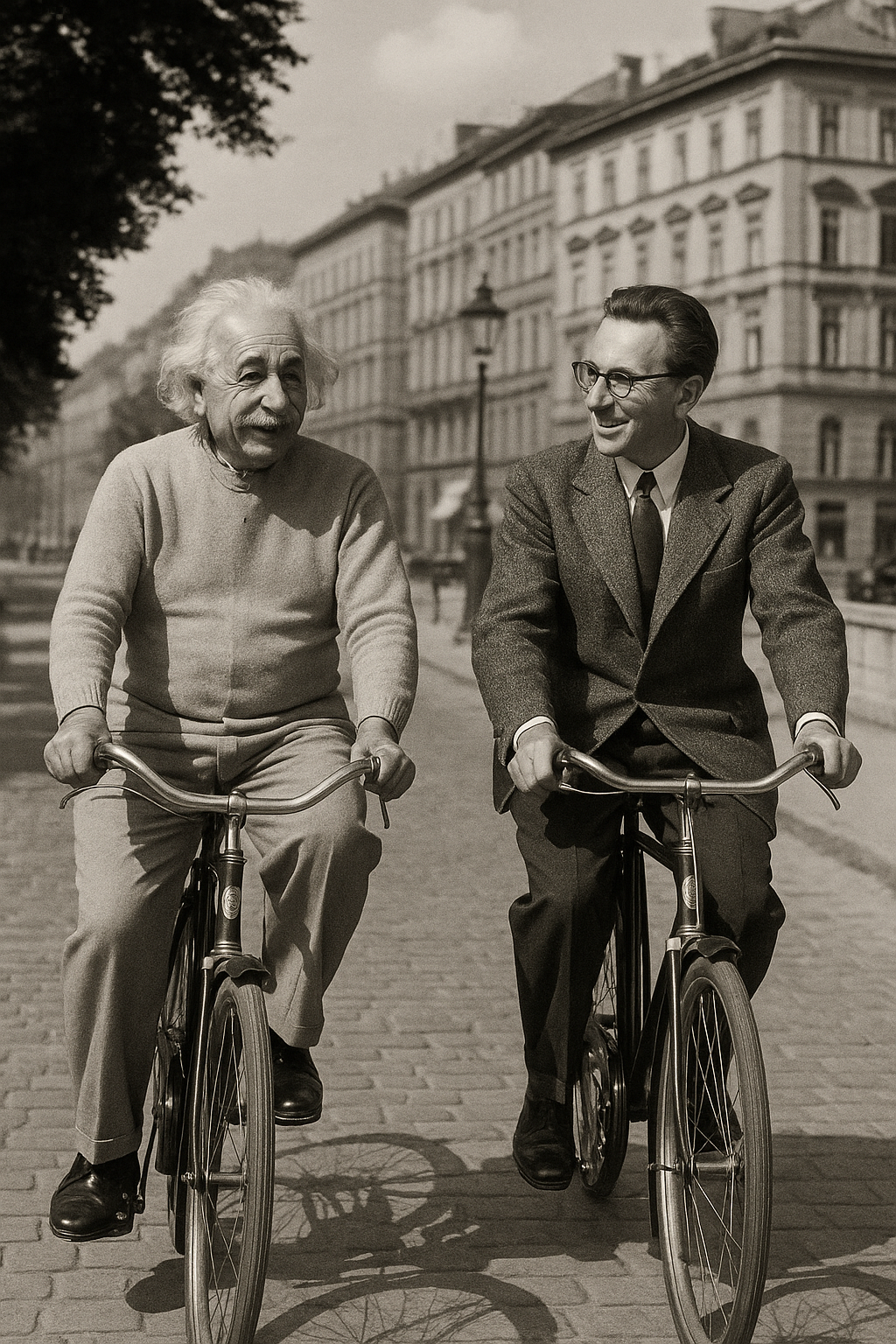
Fictional Image of Albert Einstein and Victor Frankl biking together in Vienna Austria
Category: Philosophy / Systems Thinking Reading Time: 10 Minutes
I have been spending my evenings lately in the company of two giants who, at first glance, seem to inhabit different universes. On one side of my desk sits Albert Einstein’s collection of essays, The World As I See It (1934), and on the other, I have just finished revisiting Viktor Frankl’s haunting masterpiece, Man’s Search for Meaning (1946).
Read back-to-back, these texts offer a startling contrast. Frankl writes from the absolute depths of the human experience—the concentration camp—finding light in the microscopic freedom of the individual mind. Einstein writes from the vantage point of scientific observation, looking at society holistically and systematically with a mixture of awe and concern. Yet, when you overlay their blueprints for living, a powerful synthesis emerges. It is a synthesis that explains why our current world feels so fractured, and it points directly to the mission of this blog: the urgent need to create Meaningful Systems.
Two Lives, One Moral Horizon
To understand their convergence, we must look at their origins. Einstein spent nearly twenty years in Berlin, the epicenter of scientific innovation. Frankl grew up in Vienna, the heart of psychiatry. Though they likely never met, they were two poles of the same intellectual organism—a German-speaking world dense with dialogue about science, ethics, and the human condition.
But history tore them apart. Einstein fled the rise of Nazism in 1933 to the safety of Princeton. Frankl was deported to the camps in 1942. This divergence created two distinct philosophies of meaning. Inside the camps, Frankl discovered that you can strip a human of everything—dignity, possessions, family—except one thing: "the last of the human freedoms—to choose one’s attitude in any given set of circumstances." For Frankl, meaning became an internal choice, a fortress built within the soul. Einstein, observing the drift of humanity from the outside, argued that the individual feels the "nothingness of human desires" and must seek a "cosmic religious feeling." He believed our inner and outer lives are dependent on the labors of other people, making meaning a systemic duty.
Two Layers of Human Software
Here is where the "Meaningful Systems" philosophy takes shape. Both Frankl and Einstein provide us with essential Human Software—mental models for navigating existence—but they operate at different layers of the stack.
Frankl provides the Kernel Level Software. This is the deep, internal protocol for survival. It is designed to run even when the system is crashing—when you are starving, imprisoned, or in despair. It is the "will to meaning" that functions in the dark, stabilizing the individual when all external structures fail.
Einstein provides the Application Level Software. This is the relational protocol for how we interact with the world, typically when we are not in immediate survival mode. It is the "will to truth" that guides us to serve the community, build just systems, and prioritize scientific reality over profit. While Frankl’s code saves us from breaking down, Einstein’s code guides us to build up.
The tragedy of the modern world is that while we have access to this high-level software, we are trying to run it against an External System that has shaped our very lives and every neuron in our body as a result of cultural assimilation since birth. However, the good news is that our Human Software is not static; it is always dynamically updating. We are not passive users but active programmers, and we can consciously choose to debug our code. We are capable of Frankl’s resilience and Einstein’s service, and by running their protocols, we can move away from the corrupted societal operating systems designed for the 'pigsty' of self-gratification and toward a more meaningful, fulfilling life.
The State Machine of the Soul: Phases of Human Evolution
If we view a human life not as a static event, but as a dynamic system—a "State Machine"—can map the evolution from a passive existence to a meaningful one. Based on the combined wisdom of Einstein and Frankl, we can identify the distinct states we must traverse to fix this mismatch.
Phase 1: The Sleep of the Consumer
This is the default setting for much of modern life, where we are driven by what Einstein called "thin" desires: property, outward success, and luxury. In this state, we are easily programmed by external systems and marketing narratives that prioritize profit over truth.
Consider the global food system. We are often bombarded by powerful industries—specifically the meat and dairy sectors—telling us that animal protein is the only path to health. In this "sleep state," we accept this marketing as truth, driving a system that not only compromises our personal health but creates massive environmental degradation. The mental shift occurs when we make the conscious choice to prioritize scientific reality over cultural assimilation. We choose to ignore the economic imperative of the "profit-first" narrative and embrace the ethical and ecological truth that a plant-based diet is often superior for longevity and essential for reducing the carbon footprint of agriculture. As detailed by Dr. Michael Greger in How Not to Die, the data overwhelming supports prioritizing whole, plant-based foods for health outcomes. By accepting the truth, we stop financing our own destruction and awaken to the system view.
Another example of the "Sleep of the Consumer" is the pursuit of career status. Many individuals dedicate their entire lives to chasing titles, optimizing salaries, and achieving professional milestones that are defined by external systems of prestige. This path, while financially rewarding, is often disconnected from any genuine service or ethical contribution. The profound mental shift here is the choice to anchor self-worth in contribution, not compensation or status. This does not require leaving your current job; it requires re-programming your internal goal function. Instead of asking, "How do I climb the next rung?", the architect asks, "How can I inject genuine service into my current role, even if the environment is not entirely in my control?"
A brilliant example of this is the approach of my colleague, Matt Zimmerman, who received Medtronic’s 2024 Employee Choice Award - Individual Best Demonstrating our People. Working within an existing corporate structure, Matt made the conscious Frankl’ian choice to define his purpose not by his job title, but by his relationships. He injected "joy" into the workplace by consistently giving the whole corporation uplifting messages, actively focusing on truly connecting and caring for his coworkers, and providing informal mental health support. He chose to build a micro-system of human connection and psychological safety where the corporate system demanded only output. By choosing to define value through the intrinsic ethical purpose of the contribution rather than the outward status, we stop being a side effect of the corporate machine and consciously prepare to become an architect building meaningful value.
Phase 2: The Processing (The Internal Pivot)
Eventually, the system crashes. A personal tragedy strikes, or we witness a global injustice that we can no longer ignore. This is the crisis point. Most people default to despair, but the Meaningful System Builder initiates a new processing protocol.
We see this vividly in the life of Viktor Frankl. While marching in the freezing cold, beaten by guards, starving and stripped of his manuscript, Frankl did not succumb to the immediate horror. Instead, he ran two powerful internal programs. First, he summoned the image of his wife. He realized that love was the ultimate truth, and he held a conversation with her in his mind, understanding that her presence was real to him even if she was physically gone. Second, he visualized his vocation. He transported himself out of the camp and into a warm, well-lit lecture hall in the future. He saw himself teaching a room full of students about the psychology of the concentration camp. By turning his suffering into a scientific object of study, he found the resilience to survive.
Einstein executed a similar protocol in the face of societal corruption. When the scientific community began to fracture under the weight of nationalism and war, Einstein did not retreat into cynicism. Instead, he looked to a model: H.A. Lorentz. Einstein revered Lorentz not just for his physics, but because he "never set out to dominate, but always simply to be of use." Einstein prioritized the truth of science and the unity of the international community over the profitable or safe path of nationalism.
Phase 3: The Architect (System Building)
This is the highest state of human evolution. It is the realization that we are not victims of the world, but its engineers. We stop consuming broken systems and start building better ones. Crucially, you do not need to be free to enter this state. Frankl built the system of Logotherapy in his mind while a prisoner. We, who are free, have an even greater obligation.
How does this look in the real world? It looks like a transformation of our daily labor into meaningful systems.
Consider a farmer living a hundred miles from a major city. In the old system, they might be forced into a monoculture, growing a single crop for a global commodity market that squeezes them dry and depletes the soil. But a Meaningful System Builder takes a different path. This farmer uses their land to grow a diverse set of crops, establishing a regional food co-op that connects directly to urban families. They don't just grow food; they build a system of trust and health. If we scale this, imagining a network of such farmers connecting across ten states, we create a national resilience mesh. This system ensures that when climate-induced disasters strike one region, the network can redistribute food to ensure no community goes hungry.
Consider a software engineer at a social media giant. In the old system, their goal is "engagement"—keeping users addicted to the screen to sell ads, often at the expense of the user's mental health. The Meaningful System Builder rejects this. They design a platform where the mission is enhancing human welfare. They code algorithms that optimize not for time-on-site, but for connection, directing lonely individuals toward local communities or mental health resources. They prioritize the truth of human needs over the profit of the attention economy.
The 8 Billion Person Project
The global challenges that define our century—from the injustice of human trafficking and the ancient scourge of world hunger, to the ongoing battle against mass disease—are not failures of technology; they are failures of systemic intention. These problems are perpetuated because the current operating system favors profit and passivity over truth and service. We will never conquer these immense crises if we rely solely on governments or NGOs.
The only scalable solution is a cultural one: a global shift where all 8 billion people choose to take on the role of System Architect.
Imagine a world where every single professional, regardless of their role, runs the Frankl/Einstein software. A financial analyst uses their expertise to starve the money flow of human traffickers. A supply chain manager re-engineers logistics to ensure food is redistributed immediately after a climate disaster. A doctor focuses not just on treating disease, but on building public health systems to prevent it.
This is where the collective power of international, collaborative system-building becomes unstoppable. Instead of isolated efforts, we see the rise of global teams dedicated to specific systemic failures: "Team Zero Hunger," "Team Global Health Equity," or "Team Freedom Now." These teams are composed of professionals from every nation and discipline, united by the software of truth and service. Their mission is not charity, but the creation of global, sustainable, and highly effective meaningful systems—new economic models, decentralized logistics networks, and open-source data platforms—that make human trafficking, hunger, and mass disease logistically and economically impossible to sustain. When this collective pivot occurs, we move from isolated side effects to a unified, self-healing global culture of meaning.
Einstein famously said, "The world is a dangerous place, not because of those who do evil, but because of those who look on and do nothing." I would update that for the 21st century: The world is a dangerous place because we have designed systems that make doing "nothing" the easiest option.
This is my call to action: Stop viewing yourself as a consumer of systems and start viewing yourself as a system architect.
Whether you are a parent outputting kindness in your family system, a manager regenerating the energy of your team, or a coder building the digital infrastructure of the future, you are an architect. Einstein and Frankl, separated by the tragedy of history, taught us the same lesson. Frankl taught us we have the freedom to build, even in the dark. Einstein taught us we have the duty to serve the whole. Our hope is that by understanding these layers of human software, this blog can help you update your own operating system to live a more meaningful and fulfilling life. Let us use our Frankl-given freedom to build Einstein-level systems. That is the work of our time.
