

The World as A System Optimization Problem
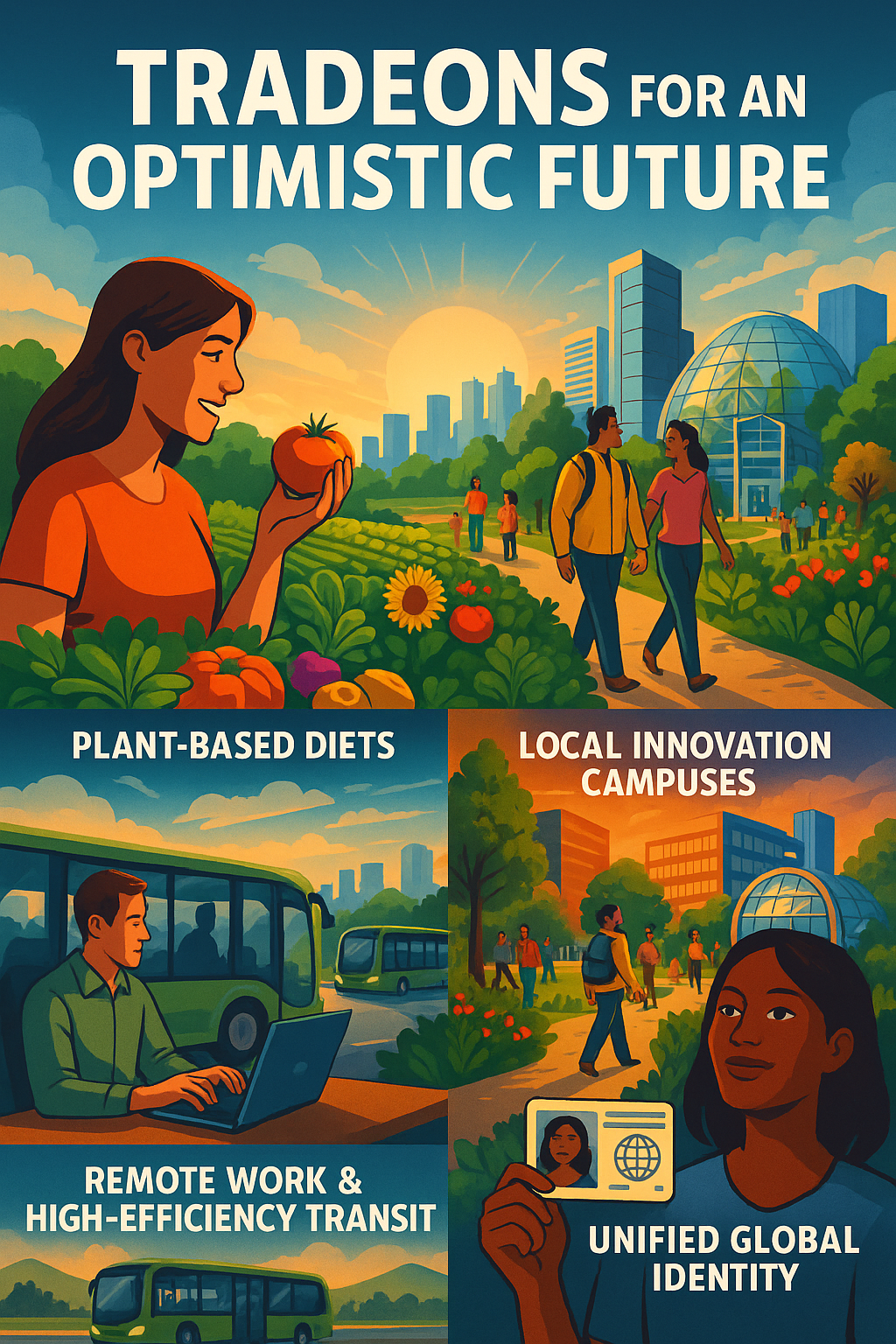
Tradeons in the Global World System for Helping Humanity Thrive
The last year, since starting Meaningful Systems, I’ve been thinking about the whole world as within scope of my systems thinking efforts. As a systems engineer who has worked on some of the hardest problems across aerospace, commercial electronics, and biomedical engineering I am very familiar with tradeoffs.
A tradeoff is when two aspects of your system have first principles that conflict with one another. So, a classic example might be a car and seating capacity trades off with fuel efficiency. Since the larger the vehicles will have more air resistance and more weight, they inherently have lower fuel efficiency. Then, in 1983, Chrysler set out to work on optimizing in this space and they came up with the first model of Minivan, the Dodge Grand Caravan and the Plymouth Voyager. These were built on a car chassis, but with higher and deeper cabin area for more passengers.
Now, what are some examples of where the world has some tradeoffs to make? Well, one example is the size of a house and its associated energy and utility costs. Another is how to generate electricity without causing significant greenhouse gases. Another is how to feed all the humans on earth without cutting down all the forests and reducing the amount of carbon sequestration potential. Some people have discussed the carrying capacity of earth for humans. Well, just like in the case of the minivan being an important innovation, there are lots of ways to innovate when the whole world is your system.
In particular, in systems problems if doing one thing differently affects multiple problems beneficially with minimal downsides, then the system designer making an elegant system will find this as an area to ensure is taken advantage of. Now, what if I told you that there was one change that we could make that would single handedly increase life expectancy across the entire population, increase carbon sequestration/mitigate climate change, reduce healthcare costs, and increase the carrying capacity of earth for humans? You’d say, well that’s not possible those areas are so unrelated it can’t be true.
However, as systems thinkers and systems innovators we must look deeper into a problem and see how subproblems within the system interrelate and where tradeoffs exist. We also have to be on the lookout for “tradeons” these are the opposite of tradeoffs in that when you have two things you want to optimize for like health of the population and climate change, this thing could potentially improve both rather than having to optimize for one or the other. This is related to symbiosis or symbiotic relationships in biology; there can also be symbiotic relationships between different parts of a complex system. For this blog, I’ll use the term “tradeon” because I think it is more clear as the opposite of a tradeoff. A tradeon, in short, is any intervention that improves multiple goals at once instead of forcing a compromise of the goals when making a choice.
Now, an elegant system designer would want to find all the “tradeons” and take advantage of them before setting out to optimize all the tradeoffs, right? Why not find the low hanging fruit in the complex system first, then figure out how to reach the apples on the top of the tree last? In practice, we need to understand the first principles of a system and the relationships within the system in order to find this low hanging fruit.
The world is such a complex system and I’m telling you tradeons exist and we are not currently taking advantage of them all. Identifying and adopting these systemic tradeons is a monumental challenge because current economic frameworks often prioritize short-term gains – e.g. companies and industries looking to maximize quarterly profits or politicians seeking re-election. This is understandable since companies are not typically scoped to find the most effective global solution, but rather find a way to make a fair profit in the complex global economy. Established practices and legacy incentives create powerful inertia that obscures more efficient, sustainable solutions. This lack of full systemic integration means many potential tradeons remain hidden or unprioritized in global strategies. Without dwelling on these structural challenges, I’ll share some of the tradeons that I can see when I look at the apple tree. I don’t comprehend the whole tree, but I do see some low hanging fruit.
For each tradeon that is discussed, I’ll first describe the related sub-problems and how they interrelate. Then I’ll explain the tradeon as I see it with associated pros and cons.
1st Tradeon: Plant Based Diet, Climate Change, and Healthcare
The first major tradeon has to do with three main sub-problems: land use, feeding the population, health care for the population, and climate change. About 77% of agricultural land is used for livestock (including growing feed for the livestock), but this land produces only about 18% of the world's human consumed calories. According to Poore & Nemecek, a global shift to a plant-based diet, “has transformative potential, reducing food's land use by 3.1 (2.8 to 3.3) billion hectares (a 76% reduction), including a 19% reduction in arable land; food's GHG emissions by 6.6 (5.5 to 7.4) billion metric tons of CO2eq (a 49% reduction)”.
The Amazon rainforest is about 0.5 billion hectares after deforestation and the Amazon basin is about 0.7 billion hectares. If we use the larger of these two numbers (more conservative), this means we could free up 3.1/0.7 or 4.4 Amazons. This land could then be repurposed to any number of other purposes! It could be used to make even more food so earth could carry a higher population, or it could be rewilded and turned into forests and prairies to sequester more CO2 and help mitigate climate change.
So, we’ve talked about the land-use and climate change sub-problems, but what about healthcare for the population? For that, there are a number of great books on the benefits of a plant-based diet. A few of my favorites are How Not to Die: Discover the Foods Scientifically Proven to Prevent and Reverse Disease, by Dr. Michael Greger, and Whole: Rethinking the Science of Nutrition by Dr. T. Colin Campbell. Both of these books talk about all the health benefits of a whole food plant-based diet. I won’t list them all, but preventing type two diabetes, preventing and reversing heart disease, reversing diabetic neuropathy or vision impairment caused by diabetes, preventing various forms of cancer, and maintaining a healthy weight are all side effects of this type of diet. Additionally, as a result of preventing certain diseases and health conditions the life expectancy increases by 10 or more years! See references below.
Those are the pros of the world adopting a whole food plant-based diet, but what about the cons? Many traditions and cultures use meat and dairy as part of holiday festivals and even weekly traditions, for example watching football in the United States and having chicken wings, brats, and burgers. However, if we zoom out to the macro view, what is most important is the shared time with family and friends and healthy plant-based alternatives can be found and created just for this purpose.
2nd Tradeon: Local Innovation Community Campuses
For those of you have experienced life on a college campus, have you ever wondered why couldn’t the rest of life be at a fun campus like this? Imagine if we built more hubs like college campuses, but for whole families and for partnerships of mega corporations, startups, schools, and local government. The core value proposition of this Symbiotic City is its function as a maximum efficiency hub, but the benefits of this proximal architecture are immediate and global.
This tradeon addresses the friction of distance and the inefficiency of "siloed" innovation. Currently, our system suffers from high latency: our biomedical engineers, food scientists, and software engineers are geographically segregated, losing massive amounts of energy and time to commuting. To solve this, we can look to the "industrial symbiosis" model found at the High Tech Campus in Eindhoven, Netherlands, or other similar campuses around the world and scale it up. Imagine a "Symbiotic City" developed 20 to 60 miles outside a major hub—perhaps near Hastings, Minnesota or Rosemount, Minnesota —built not by a single developer, but by a shared industry consortium of giants like Medtronic, Boston Scientific, Mayo Clinic, 3M, General Mills, Target, Meta, OpenAI, etc. Also, it doesn’t necessarily have to be 20+ miles outside the major city. Downtown St. Paul, Minnesota commercial real estate has struggled the last few years since the pandemic. So, perhaps there can and should be such hubs in urban areas as well. There could be space for campuses and classrooms from multiple universities, like the University of Minnesota and the University of St. Thomas. This partnership avoids the "company town" monopoly risk while creating a dense, walkable ecosystem where affordable housing provided to employees acts as a radical system constraint to ensure proximity.
In this optimized system, waste from one sector becomes fuel for another. For example, the massive heat generated by OpenAI and Meta’s data centers and supercomputers—normally a waste product—could be piped to heat vertical greenhouses run by General Mills and housing units. This could lower the energy costs through the winter in Minnesota. Furthermore, the city creates a "Nutritional Utility" via family-friendly community cafeterias. Instead of 10,000 families individually driving to grocery stores and cooking 10,000 separate meals (a massive inefficiency), families can walk to dining hubs to eat chef-prepared, whole-food plant-based meals together.
This design feature removes the domestic "second shift" for working parents while simultaneously implementing the global optimization of a whole food plant-based diet as discussed above. By making the healthiest choice the path of least resistance, this system could create a local blue zone all while fostering the cross-disciplinary collisions between food scientists, surgeons, and AI researchers that drive true innovation. Plus, perhaps there could be multi-generational living, healthcare on site, community recreation areas, libraries, and other benefits not listed.
What are the downsides? Well, if two adults in the same household are working and one has an employer who is not located in the hub, then that could be a commuting challenge for that family. Additionally, households may need to give up their large homes to move into the community. This is where the third tradeon comes into play.
3rd Tradeon: Innovation Hub + Remote Work Combination Model + Internet Connected Community Transportation Vehicles
The biggest contributor to fossil fuel consumption for knowledge workers is the daily commute. For every knowledge worker, shifting away from a five-day-a-week office schedule yields a significant reduction in fossil fuel burning. Research indicates that a worker who transitions from fully on-site to fully remote can reduce their carbon footprint by up to 54% (Tao et al., 2023). If the world were to shift to a 100% remote model (a hypothetical five days a week) for all telework-compatible jobs, the immediate fossil fuel savings would be significant. Even a modest shift, where everyone capable teleworks one day a week, is estimated to save around 24 million tonnes (Mt) of CO₂ per year globally (IEA, 2020). For companies and workers who cannot immediately relocate to a Symbiotic City, the CO2 efficiency of the hybrid model is maximized by replacing hundreds of single-occupancy vehicles with fleet-managed, automated bus-like carpools (similar to Waymo-style services). These systems pick up workers at optimized, hyper-local neighborhood points and deliver them to centralized workplaces, consolidating up to 20 commutes into a single, CO2-efficient, and ideally electric-powered internet connected unit.
This way, workers can get logged in during the commute and get work done, perhaps with seat tray tables like in airplanes. Hybrid workers who work from home two to four days per week would achieve in excess of 11% to 29% reduction in emissions by combining remote work with these high-efficiency transport commuter busses/vans (Tao et al., 2023). This strategy creates a reliable, high-efficiency bridge to the ultimate goal: a network of symbiotic cities around a metropolitan area. The combination of optimized remote-work days and high-efficiency automated mass transit ensures maximum carbon reduction across the entire system.
So, what are the downsides of such a model? The idea of hybrid work with commute assistance so the commuting time is productive doesn’t have many downsides. Companies can balance their onsite ratio preferences while individuals can have an easier time getting to work.
4th Tradeon: Unified Global Identity Systems, Security, and Anti-Trafficking
A fourth major tradeon emerges when examining the interrelationship between global mobility, human trafficking, cybersecurity, healthcare continuity, and disaster response: the creation of a unified global identity system. Today, the world relies on hundreds of fragmented identification systems—passports, national ID cards, driver’s licenses, birth certificates, tribal IDs, and visas—each governed by inconsistent standards and technologies. This fragmentation is not only inefficient but dangerous.
According to both Interpol (2018, 2020) and the United Nations Office on Drugs and Crime (2020, 2021), identity fraud and document forgery are among the primary enablers of human trafficking networks, migrant smuggling pathways, and transnational organized crime. Traffickers exploit weak identity infrastructure across borders, making it easy to move victims undetected. A unified, biometrically bound global identity—leveraging facial recognition, iris scans, or fingerprints (Jain et al., 2011)—could significantly help reduce trafficking by making forged or duplicated identities much more difficult to use, enabling near-instant cross-border identity verification, and rapidly flagging mismatches in documents or travel histories. Additionally, missing people could be identified in public places like retail stores, gas stations, etc. based on the facial recognition data.
Beyond safety, a unified identity system would also serve as a powerful tool for economic and healthcare efficiency. Identity theft and mismatched or duplicate records cost governments and healthcare systems billions of dollars annually. The World Bank’s ID4D initiative (2018) highlights that secure, portable, and universally recognized identity systems are central to economic inclusion, financial access, and fraud prevention. When combined with privacy-preserving cryptography—such as zero-knowledge proofs, which allow individuals to verify attributes like age or residency without disclosing personal data (Kosba et al., 2015; Juels et al., 2016)—a unified system can enhance personal privacy rather than diminish it.
This also ensures continuity of medical care for travelers, migrants, and displaced persons. As detailed by Crosby and Harrison (2021), millions of people lose access to medical records and proof of identity during disasters or conflicts, which creates cascading harms in emergency response. A single global identity token with strong biometric binding would allow healthcare providers to access essential medical records securely during crises, even if physical documents were destroyed.
This tradeon also extends to global climate adaptation and refugee protection. Climate-induced disasters already displace millions annually, and the loss of identity documents during floods, wildfires, and hurricanes greatly delays aid delivery, legal protections, and financial support (Crosby & Harrison, 2021). A portable, recoverable digital identity would reduce these secondary harms significantly. Although concerns remain about governance, centralization, and potential misuse, these risks can be mitigated by decentralizing the identity infrastructure (Florêncio & Herley, 2010; Kshetri & Voas, 2019). By simultaneously increasing safety, reducing trafficking, improving global healthcare continuity, strengthening cybersecurity, and improving economic efficiency, a unified global identity system represents a clear tradeon: a change that improves multiple global systems simultaneously with minimal downside when designed ethically and securely.
Discussion
Looking across these four tradeons, a unifying pattern emerges: many of our most serious global challenges are not independent problems to be solved in isolation, but tightly coupled subsystems of one shared, planetary-scale architecture. Diet, land use, climate, healthcare, work patterns, transportation, urban design, digital identity, and human rights are often managed by different institutions, disciplines, and industries—with their own metrics and incentives. Yet when we zoom out and think like systems engineers, we can see that interventions such as whole food plant-based nutrition, Symbiotic Cities, remote work plus high-efficiency transit, and unified identity infrastructure are not “single-issue” fixes. They are leverage points that push multiple subsystems in a healthier direction at the same time.
At the same time, it is important to acknowledge that implementing these tradeons in the real world is neither trivial nor purely technical. Each of these ideas runs into existing power structures, cultural norms, economic interests, and understandable fears. Moving toward plant-based diets challenges long-standing culinary traditions and large industries. Building Symbiotic Cities and hybrid commute systems asks families to rethink where and how they live and work. A unified global identity framework has to be designed with extraordinary care around privacy, equity, and governance to avoid becoming a tool of surveillance or exclusion. In other words, we are not just dealing with engineering constraints; we are dealing with historical trauma, trust, and questions of who gets to decide how the system evolves.
There are also questions of fairness and global justice. If we are going to reap the benefits of these tradeons, we must ask: who benefits first, and who bears the transition costs? How do we ensure that low-income communities, and historically marginalized groups are not once again asked to sacrifice so that others can reap the gains? An elegant global system is not just efficient; it is also inclusive and reparative. That means co-designing these changes with the communities most affected, allowing for local variation, and building governance processes that are transparent and accountable rather than top-down and technocratic.
Finally, there is epistemic humility. I am not claiming to see the full shape of the global “apple tree.” These four tradeons are simply some of the low-hanging fruit I can see from my particular vantage point as a systems engineer. There are almost certainly many tradeons I have missed, and some of the ones described here will need to be refined, challenged, or even replaced as new data and perspectives emerge. The point is not that this particular list is complete, but that the category of “tradeons” is real and underutilized. If more of us—including policymakers, business leaders, communities, and everyday citizens—start looking for interventions that improve multiple subsystems at once, we can shift from a mindset of constant compromise to one of intelligent, compassionate optimization.
Conclusion
When we treat the world as a system optimization problem, it can feel overwhelming at first. The interactions are nonlinear, the stakeholders are countless, and the constraints are constantly shifting. Yet this same complexity also creates surprising opportunities: small, well-chosen changes in the right places can ripple outward and improve health, climate, equity, and resilience all at once. The four tradeons described here—plant-based diets, Symbiotic Cities with local innovation campuses, remote work combined with high-efficiency transportation, and a unified global identity infrastructure—are examples of these leverage points. They are not silver bullets, but they demonstrate that we do not always have to accept harsh tradeoffs between human thriving, environmental stability, and economic viability.
My hope is that this way of thinking can spread beyond engineering and into everyday life. You don’t need to be a systems engineer to ask: “Where is the tradeon here? Is there a choice that improves multiple outcomes at once, instead of forcing a zero-sum decision?” That question can be applied to how we design neighborhoods, how we structure workplaces, how we vote, how we invest, how we eat, and how we show up in our communities. At a planetary scale, we will still need to wrestle with difficult tradeoffs, but if we find and implement enough tradeons first, those tradeoffs become smaller, more manageable, and less catastrophic.
Meaningful Systems, for me, is partly about building tools and models—and partly about building a new shared mindset. A mindset that sees interdependence rather than isolation, leverage rather than inevitability, and possibility rather than resignation. We may not be able to redesign the whole global system overnight, but each of us operates a “local subsystem” in our families, organizations, and communities. If we can start to notice and act on the tradeons within our sphere of influence, then collectively, over time, we can bend the larger system toward a future where both people and planet can thrive.
References
Poore, J., & Nemecek, T. (2018). Reducing food’s environmental impacts through producers and consumers. Science, 360(6392), 987–992. https://doi.org/10.1126/science.aaq0216
Cassidy, E. S., West, P. C., Gerber, J. S., & Foley, J. A. (2013). Redefining agricultural yields: From tonnes to people nourished. Environmental Research Letters, 8(3), 034015. https://doi.org/10.1088/1748-9326/8/3/034015
Shepon, A., Eshel, G., Noor, E., & Milo, R. (2018). The opportunity cost of animal based diets exceeds all food losses. Proceedings of the National Academy of Sciences, 115(15), 3804–3809. https://doi.org/10.1073/pnas.1713820115
Campbell, T. C., & Jacobson, H. (2013). Whole: Rethinking the science of nutrition. BenBella Books.
Fadnes, L. T., Økland, J. M., Haaland, Ø. A., & Johansson, K. A. (2022). Estimating impact of food choices on life expectancy: A modeling study. PLOS Medicine, 19(2), e1003889. https://doi.org/10.1371/journal.pmed.1003889
Fraser, G. E., & Shavlik, D. J. (2001). Ten years of life: Is it a matter of choice? Archives of Internal Medicine, 161(13), 1645–1652. https://doi.org/10.1001/archinte.161.13.1645
IEA. (2020). Working from home can save energy and reduce emissions. But how much? International Energy Agency.
Tao, Y., Yang, L., Jaffe, S., Amini, F., Bergen, P., Hecht, B., & You, F. (2023). Climate mitigation potentials of teleworking are sensitive to changes in lifestyle and workplace rather than ICT usage. Proceedings of the National Academy of Sciences, 120(39), e2304099120.
Interpol. (2018). Global study on smuggling of migrants. Interpol General Secretariat. https://www.interpol.int
Interpol. (2020). Human trafficking and migrant smuggling: Fact sheet. Interpol General Secretariat.
United Nations Office on Drugs and Crime. (2020). Global report on trafficking in persons 2020. United Nations. https://www.unodc.org
United Nations Office on Drugs and Crime. (2021). Toolkit for mainstreaming human rights and gender equality into criminal justice interventions to address trafficking in persons and smuggling of migrants. United Nations.
Crosby, S., & Harrison, K. (2021). Digital identity in crisis response: Enhancing protection and service delivery for displaced populations. Journal of International Humanitarian Action, 6(1), 1–14. https://doi.org/10.1186/s41018-021-00102-8
World Bank. (2018). ID4D enabling digital identification for development. World Bank Group. https://id4d.worldbank.org
Jain, A. K., Ross, A. A., & Nandakumar, K. (2011). Introduction to biometrics. Springer.
Kosba, A., Papamanthou, C., & Shi, E. (2015). Nullification attacks on zero-knowledge proofs. Proceedings of the 2015 IEEE Symposium on Security and Privacy, 369–384. https://doi.org/10.1109/SP.2015.31
Kshetri, N., & Voas, J. (2019). Blockchain-enabled e-identities. IEEE Computer, 52(3), 74–79. https://doi.org/10.1109/MC.2018.2888760
Juels, A., Kosba, A., & Shi, E. (2016). The ring of Gyges: Investigating the future of anonymous blockchain transactions. Communications of the ACM, 59(11), 38–43. https://doi.org/10.1145/2994581
Florêncio, D., & Herley, C. (2010). Where do security policies come from? Proceedings of the Sixth Symposium on Usable Privacy and Security, 1–14. https://doi.org/10.1145/1837110.1837113
