

Moon and Mars Settlement: How Reaching Other Worlds Can Help Earth Thrive
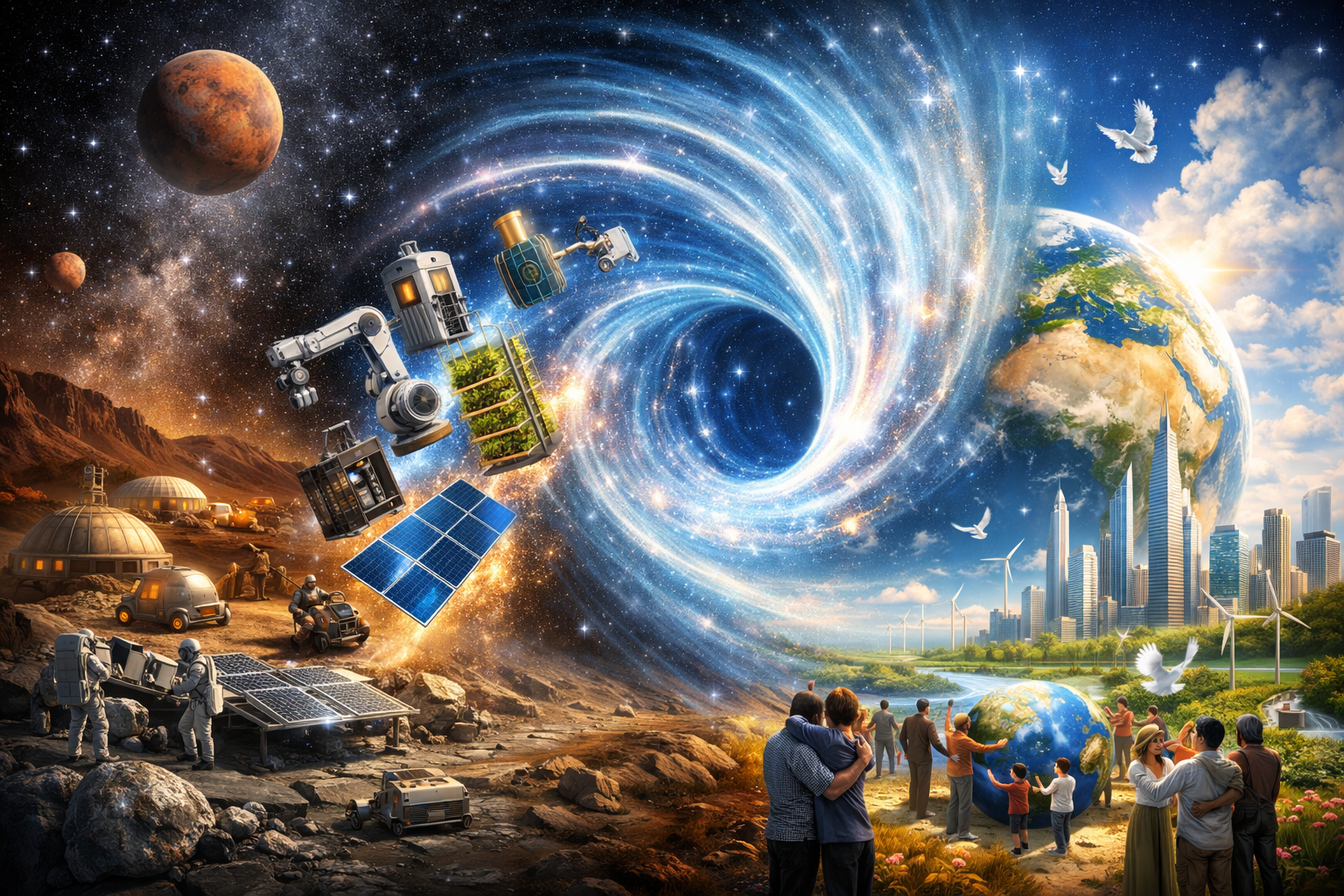
The Flow of Technologies and Scientific Discoveries from Space Exploration Back to Earth
Introduction
Over spring break, a family member asked me a simple but serious question: given the scale of U.S. federal debt, should we really be investing in the Moon and Mars at all? Then, last week a colleague I respect very much asked me to “think about humanity overall, how does going to the moon and Mars help us?”
These questions stayed with me. And now, on the heels of Artemis II — NASA’s first crewed lunar flyby mission of the Artemis era — it feels even more relevant. Artemis II is not just a launch. It is a public reminder that human beings can still do astonishing things when science, engineering, and long-term ambition line up. NASA’s current Artemis framing is not only about repeating Apollo. It is about building toward a lasting lunar presence and, ultimately, Mars. NASA’s recent “Ignition” event pushed that even further, pairing Moon missions with a broader push toward a stronger low Earth orbit economy, a Moon base, and a larger orbital future (NASA, 2026a, 2026b, 2026c).
I do not think the debt question should be dismissed. But I do think it may be incomplete. Last year, I wrote about “The World as a System Optimization Problem” and introduced the concept of a tradeon. This is defined as “any intervention that improves multiple goals at once instead of forcing a compromise of the goals when making a choice” (Fried, 2025). The better question is whether we are thinking broadly enough about what it might return – perhaps what we learn and the technology we develop can be reused or repurposed on Earth. What if Moon and Mars work is not only about survival, prestige, or adventure? What if it is also one of the best forcing functions we have for inventing the next generation of closed-loop water systems, stacked agriculture, resilient power, tough materials, and healthier ways of living together on Earth? That is the question I have been thinking about since spring break.
A Better Reason Than Survival
One argument for settlement beyond Earth is survival. Build redundancy. Protect the species. Create a backup.
That argument is valid, but I think it is too small. If the highest goal is only to keep the species alive somewhere, we risk optimizing for persistence instead of flourishing or thriving. The far more interesting possibility is that off-world settlement could become a giant tradeon: a systems move that advances multiple goals at once. Instead of forcing a false choice between helping Earth and exploring beyond it, we may be able to do both — if we design for both.
The Moon and Mars are brutal design environments. They punish waste, fragility, delay, dust, inefficiency, and social dysfunction. That means any system good enough to support human life there has a real chance of teaching us how to build better systems here.
Water: What If Cities Reused Water Like a Space Habitat?
If you were building a Moon base, you would not design a water system that uses water once and throws it away. You would design something much closer to a loop.
That is already starting to happen on Earth, just in pieces. Orange County’s Groundwater Replenishment System is now the world’s largest water purification system for indirect potable reuse, taking treated wastewater that would otherwise have gone to the ocean and turning it into a drought-resistant water supply (Orange County Water District, n.d.; U.S. Environmental Protection Agency [EPA], 2024). Singapore’s NEWater system does something similarly bold, recycling treated used water into ultra-clean reclaimed water through membrane and ultraviolet treatment; Singapore explicitly treats this as part of its long-term water-security strategy (EPA, 2026; PUB, 2024).
Now imagine taking the design pressure of a Moon or Mars settlement — where every liter matters — and pushing that mindset into buildings, neighborhoods, campuses, and whole cities. In Minnesota, that might eventually mean buildings reclaiming graywater locally for toilet flushing, irrigation, or district reuse. In California or the Colorado River Basin, it could mean a future where freshwater withdrawal is cut not only by conservation, but by much more aggressive reuse. The point is not that every house becomes a miniature spacecraft. The point is that harsh-environment habitation forces us to think like closed-loop engineers, and that mindset could radically improve terrestrial water resilience.
Agriculture: The First Truly Three-Dimensional Farms
If we ever feed large numbers of people on the Moon or Mars, we will not do it with a few soybeans in a flowerpot and a tractor in a field. We will do it with enclosed, instrumented, intensely managed systems that make every square foot and every drop of water count.
The interesting thing is that this is no longer science fiction on Earth. USDA’s Agricultural Research Service has described vertical farming as capable, for some crops, of producing roughly 10 to 20 times the yield per acre of open-field agriculture. USDA’s Economic Research Service now treats controlled-environment agriculture as a serious emerging production system, not just a novelty (Dohlman et al., 2024; USDA Agricultural Research Service, 2025). Peer-reviewed work in Nature and related journals now describes controlled-environment agriculture as capable, in some contexts, of delivering 10-to-100-times higher annual yields per unit land area while also sharply reducing water use and protecting crops from climate volatility (Wang et al., 2025; Zou et al., 2025).
NASA has been quietly helping lay the groundwork for this for decades. NASA’s space-crop and bioregenerative life-support research has focused on how to grow food in closed environments with carefully managed water, nutrients, lighting, and atmosphere (NASA, 2023a, 2023b). NASA spinoff reporting goes further: the agency explicitly ties its closed-environment plant-growth work to the rise of U.S. indoor farming and even describes research lineage behind the first vertical farm in the United States (NASA Spinoff, 2021, 2024a). One especially vivid example is rotary aeroponics: a compact rotating column that moves plants past a light source while optimizing hydration, humidity, and airflow in an enclosed environment (NASA Spinoff, 2026).
That is the tantalizing part. A Moon or Mars settlement would force agriculture to become three-dimensional, water-thrifty, and data-rich. It would also force plant-level care. USDA’s National Agricultural Library has already described agriculture as moving toward “individual plant” management, where robotics and automation care for crops at the same granularity as the data we collect about them (USDA National Agricultural Library, n.d.). That means a future in which robots do not merely drive through fields like smaller tractors; they inspect each plant, notice leaf stress, detect nutrient deficiency, adjust watering, and intervene early. Moon farming could help teach Earth agriculture how to move from coarse bulk treatment to plant-by-plant intelligence.
Power: From 100-kW Microreactors to Lunar Grids
A serious settlement on the Moon will need more than a few solar panels and some batteries. It will need power systems that work through darkness, dust, cold, thermal cycling, and partial failures. In other words, it will need power systems that are boring in the best possible way: reliable, abundant, and hard to break.
NASA and DOE are already moving in this direction. In January 2026, NASA and DOE announced plans to develop a lunar surface reactor by 2030, explicitly to provide continuous and abundant power for sustained lunar missions regardless of sunlight or temperature (NASA, 2026d). NASA’s fission surface power program builds on Kilopower, a small space fission effort demonstrated in 2018, and on newer 10-kWe and 40-kWe lunar concepts studied through NASA’s Compass team (Mason et al., 2011; NASA, 2025a; Oleson et al., 2022a, 2022b).
And while that is happening on the space side, Earth-side microreactor work is already real. DOE’s MARVEL project at Idaho National Laboratory is a sodium-potassium-cooled microreactor in roughly the 100-kW thermal class, designed as a flexible test bed that can support microgrids, heat applications, and other end uses (DOE Office of Nuclear Energy, n.d.; Idaho National Laboratory, 2026). MARVEL is not a Moon reactor. But it is exactly the kind of stepping-stone technology that makes the whole idea feel less like fantasy and more like a trajectory.
And then there is fusion. Fusion is still not a commercial plug-and-play power source, and this blog won’t pretend otherwise. But it is moving. DOE’s 2025 fusion roadmap is explicitly organized around the science and technology gaps that must be closed to reach fusion pilot plants, while ITER continues to push toward burning-plasma-scale demonstration (DOE Office of Science, 2025a, 2025b; ITER Organization, n.d.). If humanity ever wants city-scale off-world settlements with huge numbers of robots, intense lighting loads for agriculture, industrial processing, and round-the-clock operations, the demand for compact, high-density clean power could become an enormous driver for these technologies.
Heat is a Huge Bottleneck
One of the least glamorous but most important challenges on the Moon is thermal management. The problem is not just that the Moon gets very hot in sunlight and very cold in darkness. It is also that lunar regolith is a poor thermal conductor, so the ground is not a very effective place to dump large heat loads quickly. NASA’s Lunar Thermal Analysis Guidebook describes regolith as a thermal insulator with low thermal diffusivity and notes that large temperature gradients can exist between the surface and material just a short distance below it (Hamill, 2021). In practical terms, that means a lunar base with habitats, reactors, industrial systems, and computing would need carefully engineered thermal loops, heat transport systems, thermal storage, and radiators rather than assuming the environment will conveniently absorb waste heat (Hamill, 2021).
That matters on Earth because AI hyperscale data centers and future fusion plants are running into their own heat-rejection limits. The U.S. Department of Energy has highlighted advanced cooling as a major need for data centers, announcing major funding for more efficient cooling technologies as computing demand rises (DOE, 2023). Fusion faces an even more intense version of the same problem: DOE’s fusion science and technology roadmap identifies heat exhaust as a major challenge on the path to commercial fusion energy (DOE, 2025c). So the same knowledge that would help a lunar settlement survive long hot-cold cycles, poor ground heat conduction, and limited heat-rejection pathways could also help Earth build denser, more efficient AI data centers and more practical fusion-energy systems. Additionally, since the moon is not a water rich environment, perhaps the cooling can be done in closed loop systems in the future rather than wasting fresh water for terrestrial cooling. In that sense, the Moon is not just a destination. It is a forcing function for learning how to move, store, and reject heat under extreme constraints (Hamill, 2021; DOE, 2023, 2025c).
Solar That Hates Dust, Snow, and Neglect
Even ordinary solar starts to look different when you imagine using it on the Moon or Mars. Dust is not a minor annoyance there. Over long periods, radiation exposure can degrade materials and photovoltaic performance, and micrometeoroid impacts can damage exposed solar surfaces and interconnects. Designing solar systems that can survive for decades — let alone a century — in that kind of environment is no small challenge. NASA’s work on space environmental effects and lunar materials makes clear that ultraviolet radiation, ionizing radiation, and micrometeoroid exposure are all important long-term design concerns for systems operating beyond Earth’s atmosphere (Silverman, 1995; Severino et al., 2020; Nahra, 1989).
That is one reason I find current anti-soiling and anti-icing work so exciting. Peer-reviewed coatings research is now demonstrating transparent self-cleaning surfaces, superhydrophobic layers, and bifunctional anti-dust/anti-icing coatings for photovoltaics. One 2026 study reported a transparent coating with average transmittance above 83%, delayed ice formation, and improved snow/ice shedding; other recent reviews describe anti-soiling, anti-reflective, and self-cleaning solar coatings as an active frontier for improving long-term performance in harsh environments (Duan et al., 2026; Padhan et al., 2025).
That is exactly the sort of thing a Moon settlement could accelerate: not just “better solar,” but solar that is almost offended by dust, snow, radiation, or meteorites. The same ideas could matter in deserts, snowy climates, remote villages, military outposts, wildfire zones, and anywhere cleaning and maintenance are expensive or unreliable.
Tougher Materials for Harsher Worlds
Space habitats also force another question: what materials survive when the environment is trying to kill them?
NASA’s work on GRX-810 is a good taste of what that future might look like. GRX-810 is a NASA-developed oxide-dispersion-strengthened alloy that can tolerate temperatures above 2,000°F and survive more than 1,000 times longer than current state-of-the-art alloys in some tests (NASA, 2022). Meanwhile, NASA materials work has explicitly identified multifunctional radiation shielding and extreme-environment structures as major challenges for off-world human habitats (Nguyen et al., 2017). On the Earth side, NIST is actively working on resilience and fire, including wildland-urban-interface building and fire codes intended to make communities less vulnerable to multi-hazard events (NIST, 2011, 2026).
Now imagine where those streams converge. A material system developed for extreme temperature swings, radiation exposure, abrasion, and impact tolerance in a lunar or Martian habitat may not be identical to what California, Colorado, or Australia needs for wildfire-resilient buildings. But the overlap is large enough to be exciting. Better thermal envelopes, tougher shielding layers, lighter high-temperature alloys, high temperature tolerant insulation, and more resilient modular structures could end up serving both worlds.
Living Well in Small Spaces
The last example may be the most important, because it is the most human.
A Moon or Mars settlement will not succeed on engineering alone. It will also have to solve for loneliness, stress, privacy, cohesion, routine, and meaning in square-foot-constrained environments. NASA has long treated isolation and confinement as serious hazards for exploration crews, and current analog research continues to study how people perform psychologically and socially in these conditions (NASA, 2018; Whitmire et al., 2025).
That matters on Earth, too. WHO now treats social connection as a significant public-health issue, linking it to mental health, physical health, and community well-being (World Health Organization, 2025a, 2025b). Housing research is also beginning to show that cooperative housing and related shared-space models may reduce isolation and improve well-being when designed well (Alday-Mondaca & Schiff, 2025).
So maybe one of the most surprising Moon-to-Earth tradeons is not just technology. Maybe it is habitat philosophy. Private quarters plus shared kitchens. Family meals plus community life. More belonging, less isolation. Better use of land, infrastructure, and real estate. Not because everyone should live in a commune, but because off-world settlement may force us to get more serious about designing for human flourishing instead of just physical shelter. If migration is necessary to more temperate climate areas of the world, perhaps these things can help us find better ways of living together harmoniously with less space.
Conclusion
My family member’s question was fair: given our federal debt, why should we invest in the Moon and Mars? My colleague’s question also hit me hard and was part of the purpose of this blog. My answer to both these questions is that the value proposition may be much larger than it first appears. Not because space is magically worth any price. Not because every rocket launch automatically improves life on Earth. But because the design pressures of lunar and Martian settlement are so extreme that they may help force breakthroughs we badly need anyway.
Closed-loop water. Three-dimensional farming. Plant-level robotics. Microreactors and fusion pathways. Advanced thermal management technology. Solar that shrugs off dust and snow. Tougher materials. Better habitats for the human mind. This is just a short list I’ve come up with since being asked these questions. I’m sure there are many more tradeons and technologies that could be developed to help the world.
That is the more exciting possibility. Reaching other worlds may help us build a better one here. What other areas do you see that space technology could help with challenges on Earth?
References
Alday-Mondaca, C., & Schiff, R. (2025). Cooperative housing: A catalyst for health and wellbeing? A scoping review of English and Spanish literature (2004–2024). Wellbeing, Space and Society.
Dohlman, E., Maguire, K., Davis, W. V., Husby, M., Bovay, J., Weber, C., & Lee, Y. (2024). Trends, insights, and future prospects for production in controlled environment agriculture and agrivoltaics systems (Report No. EIB-264). U.S. Department of Agriculture, Economic Research Service.
Duan, Y., Hou, G., Guo, B., Yuan, B., Wang, X., Lu, S., & Wu, X. (2026). A bifunctional transparent anti-icing and anti-dust coating. Progress in Organic Coatings.
Fried, A. (2025). The world as a system optimization problem. Meaningful Systems. https://www.meaningfulsystems.com/blog/11
Hamill, B. D. (2021). Lunar thermal analysis guidebook. NASA.
Idaho National Laboratory. (2026). DOE approves safety documentation for MARVEL microreactor initial criticality.
ITER Organization. (n.d.). ITER: The way to new energy; What is fusion?
Mason, L. S., Bailey, S. P., & others. (2011). A summary of NASA architecture studies utilizing fission surface power systems. NASA.
Nahra, H. K. (1989). Effect of micrometeoroid and space debris impacts on the degradation of space station solar array electrical power generation. NASA.
NASA. (2018). Hazard: Isolation and confinement.
NASA. (2022). NASA’s new material built to withstand extreme conditions.
NASA. (2023a). Growing plants in space.
NASA. (2023b). Plant Water Management.
NASA. (2025a). Fission surface power.
NASA. (2026a). What you need to know about NASA’s Artemis II moon mission.
NASA. (2026b). NASA unveils initiatives to achieve America’s national space policy.
NASA. (2026c). Igniting golden age of exploration, innovation [Fact sheet].
NASA. (2026d). NASA, Department of Energy to develop lunar surface reactor by 2030.
NASA Spinoff. (2021). NASA research launches a new generation of indoor farming.
NASA Spinoff. (2024a). Next-level farming.
NASA Spinoff. (2026). Greens grow in circles.
National Institute of Standards and Technology. (2011). Wildland-urban interface building and fire codes and standards.
National Institute of Standards and Technology. (2026). Materials and structures for resilience program.
Oleson, S. R., McTernan, J. K., & others. (2022a). A deployable 40 kWe lunar fission surface power concept. NASA.
Oleson, S. R., McTernan, J. K., & others. (2022b). 40 kW fission surface power system deployability. NASA.
Orange County Water District. (n.d.). Groundwater Replenishment System.
Padhan, A. K., & others. (2025). High-performance multi-functional solar panel coatings. RSC Applied Polymers.
PUB, Singapore’s National Water Agency. (2024). NEWater.
Severino, C., et al. (2020). Platform design for material exposure to space and lunar environmental effects. NASA.
Silverman, E. M. (1995). Space environmental effects on spacecraft. NASA.
U.S. Department of Energy, Office of Nuclear Energy. (n.d.). MARVEL microreactor project.
U.S. Department of Energy. (2023, May 9). DOE announces $40 million for more efficient cooling of data centers.
U.S. Department of Energy, Office of Science. (2025a). Energy Department announces fusion science and technology roadmap to accelerate commercial fusion energy.
U.S. Department of Energy, Office of Science. (2025b). Fusion energy sciences.
U.S. Department of Energy. (2025c). Fusion science & technology roadmap.
U.S. Environmental Protection Agency. (2024). Orange County Water District’s Groundwater Replenishment System.
U.S. Environmental Protection Agency. (2026). Summary of Singapore’s water reuse guideline or regulation for industry.
U.S. Department of Agriculture Agricultural Research Service. (2025). Vertical farming – no longer a futuristic concept.
U.S. Department of Agriculture National Agricultural Library. (n.d.). Advancements in robotics and automation.
Wang, L., & others. (2025). Finding sustainable, resilient, and scalable solutions for controlled-environment agriculture. Nature Reviews Clean Technology.
Whitmire, A., & others. (2025). NASA approaches for isolation and confinement studies.
World Health Organization. (2025a). Social connection linked to improved health and reduced risk of early death.
World Health Organization. (2025b). Social connection.
Zou, H., & others. (2025). Next-generation water-saving strategies for greenhouses. Nature Communications.
